

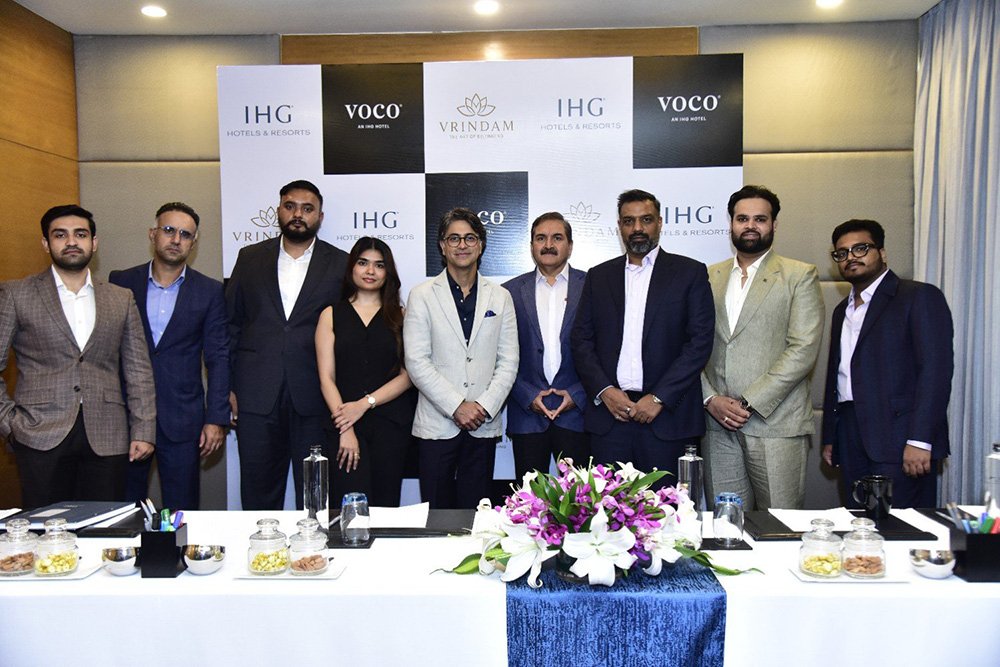
The planned hotel will add an international premium brand to one of India’s busiest pilgrimage destinations, combining accommodation, dining and extensive event facilities in a mixed-use development.
IHG Hotels & Resorts is adding another property to its expanding India pipeline with the signing of voco Vrindavan, a 130-key hotel scheduled to open in the first quarter of 2031.
The management agreement with Vrindam Developers Private Limited will bring IHG’s voco brand to Vrindavan in Uttar Pradesh, marking the developer’s first move into the hospitality sector. For IHG, the signing strengthens its premium presence in North India and extends its reach into a destination whose visitor economy is closely tied to pilgrimage, culture and the wider Braj region.
Vrindavan and neighbouring Mathura attracted more than 90 million visitors in 2024, according to IHG, compared with 79 million in 2023. The company says annual arrivals across the two destinations could reach between 110 million and 140 million over the next decade, although those figures are projections rather than confirmed future visitor numbers.
A New Hospitality Proposition for Vrindavan
The proposed hotel will form part of a larger mixed-use development incorporating hotel accommodation and serviced apartments with shared amenities.
The property is planned to have 130 guestrooms, including 13 suites, alongside three dining outlets: an all-day dining restaurant, a separate restaurant and a lobby lounge.
There will also be more than 2,340 square metres of meeting and event space spread across six venues, including a 1,400-square-metre ballroom. A swimming pool and fitness centre are also planned.
The scale of the event facilities gives the hotel a role beyond serving pilgrims and leisure travellers. Weddings, social celebrations, corporate gatherings and other group events are expected to form part of the business mix, creating a property designed to operate across several segments of the destination’s visitor economy.
Why Vrindavan Matters
Vrindavan occupies a distinctive position in India’s tourism landscape. The city is one of the principal pilgrimage centres associated with the Braj region and attracts visitors from across India as well as international travellers.
That steady flow has created growing demand for accommodation, particularly as infrastructure around the destination develops.
IHG points to improved connectivity with Delhi NCR, Agra and Mathura, together with infrastructure projects including the Banke Bihari Corridor and improved expressway links, as factors that could support further growth in visitor numbers. These infrastructure developments are part of the wider destination-growth rationale behind the new hotel.
For international hotel groups, the opportunity is increasingly not limited to India’s established metropolitan and leisure markets. Pilgrimage destinations with large and consistent visitor volumes are emerging as important locations for branded accommodation, particularly where travellers are looking for predictable standards alongside the cultural experience of the destination.
voco’s More Relaxed Approach
voco is positioned within IHG’s premium portfolio, but its proposition differs from the more formal character traditionally associated with luxury and upscale international hotels.
The brand is built around individual hotel character combined with the consistency of a global hospitality group. Its positioning emphasises informal service, distinctive design and small touches intended to make the experience feel less conventional.
That positioning could prove particularly relevant in Vrindavan, where the hotel will need to accommodate very different types of travellers—from pilgrims and families to leisure visitors, wedding groups and corporate clients.
Rather than presenting the property solely as a conventional pilgrimage hotel, the development is being designed as a broader hospitality destination with dining, recreation and event facilities.
IHG Continues to Build in the Braj Region
voco Vrindavan will not be IHG’s only planned presence in the immediate area.
The company already has an upcoming Holiday Inn Express in nearby Mathura, giving the group two different brands serving the wider Braj tourism circuit. The distinction between the brands will allow IHG to address different segments of demand as the regional accommodation market develops.
The Vrindavan signing also forms part of a much larger expansion programme in India. IHG says it currently operates 53 hotels across seven brands in India, with a further 110 hotels in its pipeline for the next three to five years.
The company has been expanding beyond India’s major urban centres, with recent signings targeting destinations where tourism demand is being supported by pilgrimage, leisure, business travel and improving infrastructure.
A Long-Term Bet on Branded Pilgrimage Hospitality
The planned opening of voco Vrindavan is still several years away, but the signing reflects a wider change in India’s hotel development landscape.
As pilgrimage destinations attract increasingly large visitor volumes, the accommodation market is becoming more sophisticated. Travellers may arrive for religious reasons, but their expectations around comfort, dining, family facilities and service standards are increasingly similar to those found elsewhere in the leisure market.
The new hotel is therefore being designed around more than overnight pilgrimage stays. Its combination of guestrooms, suites, restaurants, leisure facilities and substantial event space gives it the flexibility to serve a wider visitor base and potentially capture demand from celebrations and business gatherings as well.
For Vrindavan, the arrival of an international hotel brand represents another step in the formalisation of its hospitality infrastructure. For IHG, it is an opportunity to establish the voco brand in a destination where spiritual travel is generating a visitor economy on a scale few pilgrimage centres can match.