
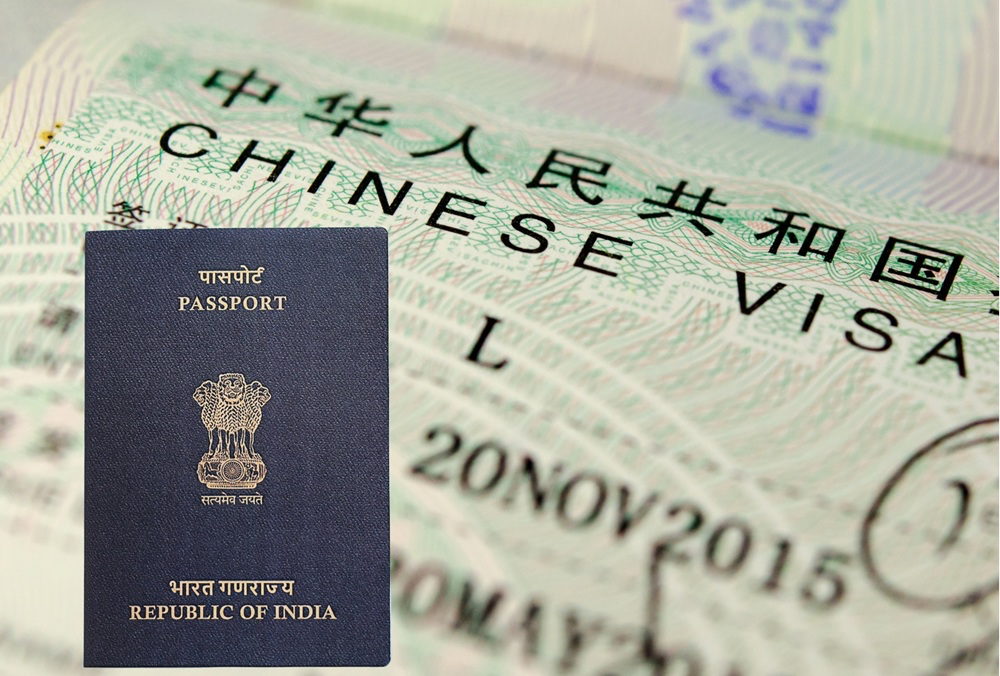
Applicants will submit visa applications directly to the Chinese Embassy in New Delhi or the Consulate General in Mumbai under revised procedures, while residents of eastern India will temporarily be served by the Embassy.
China is revising its visa application and consular legalisation procedures in India, with the new arrangements taking effect on October 26, 2026. Under the revised system, the Chinese Embassy in New Delhi and the Consulate General in Mumbai will directly accept and process applications, replacing the existing submission arrangements through Chinese Visa Application Centres.
The change also affects applicants in the jurisdiction previously served by the Chinese Consulate General in Kolkata. Their applications will temporarily be handled by the Embassy in New Delhi, according to an official notice issued by the Chinese Embassy in India on October 22.
The revised procedures apply to visas for mainland China. Travellers visiting Hong Kong and Macao must follow the respective immigration and visa requirements for those special administrative regions.
Where applicants must submit their applications
The Chinese authorities have specified the jurisdiction for visa applications according to the applicant’s place of residence.
- Mumbai Consulate General: Applicants residing in Maharashtra and Karnataka must apply through the Consulate General in Mumbai.
- New Delhi Embassy: Applicants residing in West Bengal, Bihar, Jharkhand, Odisha and Chhattisgarh must temporarily submit their applications to the Embassy in New Delhi.
- Other Indian states and territories: Applicants residing outside the states listed above must also apply through the Embassy in New Delhi.
For consular legalisation, the jurisdiction is determined by the place where the relevant document was issued, rather than the applicant’s place of residence.
Online applications remain the first step
Applicants must begin the process through the Chinese Ministry of Foreign Affairs’ online visa application portal: https://consular.mfa.
The application form must be completed online, with the required supporting documents uploaded for preliminary review. No payment is required at this stage.
Once the online application receives approval, the applicant will be notified by email. The applicant must then visit the designated Embassy or Consulate within 30 days to submit the passport, application form and supporting documents. Fingerprints will be collected where required.
Applicants seeking diplomatic, official or courtesy visas must arrange an appointment by telephone before submitting their documents.
Visa fees are payable when collecting the passport on the date specified on the collection slip.
The Embassy advises applicants to check the latest instructions before submitting their documents, particularly where additional information or supporting evidence may be required.
Documents required for a Chinese visa
Applicants must generally provide a completed visa application form and a passport valid for more than six months, with at least two blank visa pages. The passport information page and any previous passport issued during the preceding five years must also be provided.
Two recent colour photographs, measuring 48 mm × 33 mm and taken against a white background within the previous six months, are required.
Non-Indian nationals applying in India must submit valid evidence of their immigration or residence status, such as a visa or relevant residence, employment or study documentation. Details of Chinese visas obtained during the previous three years must also be supplied, where applicable.
Applications for minors require additional documentation, including a birth certificate, the guardian’s identity document and a consent letter. Where an application is submitted through a travel agency or another representative, the agency’s qualification documents and the representative’s identity document must be included.
Requirements vary by visa category
The supporting documents depend on the purpose of travel.
Tourist visa (L): Applicants must provide the relevant travel documentation, including an itinerary and supporting evidence of accommodation and travel arrangements. The Embassy’s published requirements also specify personal savings account statements covering the previous six months, showing a consistent average monthly balance of at least ₹1 lakh, or an eligible deposit certificate for a similar amount. The deposit certificate must have been issued at least three months before the application date and carry the bank’s official seal and signature. Additional documents may be requested depending on individual circumstances.
Business visa (M): Applicants must provide an invitation from the Chinese business partner or relevant organisation, along with supporting commercial documentation. The Embassy specifies detailed requirements for the invitation letter, the inviting company’s business licence and the applicant’s cover letter.
Exchange and non-commercial visits (F): An invitation letter from the relevant organisation or individual in China is required.
Transit visa (G): Applicants must provide confirmed onward transport tickets for travel to another country or region.
Employment visa (Z): The required documentation includes the applicable Short-term Work Permit in China for Foreigners or Notice for Foreigner’s Work Permit.
Student visas (X1 and X2): The X1 category covers study programmes lasting more than 180 days, while X2 applies to programmes of 180 days or less. Applicants must provide the relevant admission and educational documents.
Other visa categories cover permanent residence, family visits, journalism, high-level talent and international transport crew members. Applicants should consult the Embassy’s category-specific instructions to establish the precise requirements for their circumstances.
Chinese visa fees and payment arrangements
The Chinese Embassy’s updated fee schedule lists the following charges for Indian passport holders.
| Visa category | Fee |
|---|---|
| Single-entry visa | ₹2,900 |
| Double-entry visa | ₹4,400 |
| Six-month multiple-entry visa | ₹5,900 |
| Multiple-entry visa valid for 12 months or longer | ₹8,800 |
| Group visa, per applicant | ₹1,800 |
| Official group visa, per applicant | ₹1,800 |
For many third-country passport holders, excluding nationalities subject to separate fee arrangements, the published charges are ₹2,000 for a single-entry visa, ₹3,000 for a double-entry visa, ₹4,100 for a six-month multiple-entry visa and ₹6,100 for a multiple-entry visa valid for 12 months or longer. Fees vary by nationality, and applicants should check the applicable rate with the relevant mission.
Express processing costs an additional ₹1,800, while urgent processing, where available, costs ₹2,700.
The Embassy and Consulate General are temporarily accepting payments only by demand draft. Cash, personal cheques and other payment methods are not accepted.
Demand drafts must be printed by the issuing bank. Applicants must write their full name, collection slip number and contact telephone number on the reverse.
For applications handled in New Delhi, the draft must be payable to CHINESE EMBASSY, NEW DELHI. For applications handled in Mumbai, it must be payable to CONSULATE GENERAL OF THE PEOPLE’S REPUBLIC OF CHINA IN MUMBAI.
Fingerprinting and processing times
The Embassy’s updated guidance provides for an exemption from fingerprint collection through December 31, 2026, for applicants seeking short-term visas for stays of no more than 180 days, subject to the applicable rules and exceptions.
Fingerprint collection generally remains necessary for certain long-term visa categories, including D, J1, Q1, S1, X1 and Z visas where applicants need to obtain a residence permit after arrival, as well as for multiple-entry visa applications, in accordance with the Embassy’s guidance.
The published processing times, calculated from the day after the passport is submitted, are seven working days for regular processing and four working days for express processing. Actual timelines may depend on the application and any additional checks required.
Travellers should allow sufficient time for both online review and physical document submission when planning their trips.
Consular legalisation moves to direct submission
The revised arrangements also cover consular legalisation of documents intended for use in mainland China. Applications may be submitted directly to the designated Embassy or Consulate without an appointment.
Applicants must provide the prescribed application form, valid identity documents, and the original document requiring legalisation together with a copy.
Documents issued by Indian authorities for use in mainland China must first be notarised in India and legalised by the Consular Department of India’s Ministry of External Affairs or its authorised offices. They must then be submitted for Chinese consular legalisation in accordance with the prescribed requirements.
The Chinese Embassy confirms that the Hague Convention abolishing the requirement for legalisation of foreign public documents does not apply between India and mainland China. Relevant public documents exchanged between the two therefore continue to require consular legalisation.
Regular legalisation processing takes four working days. An express service of two to three working days is available through the Embassy. Applications by post or fax are not accepted.
Separate arrangements govern documents exchanged with Hong Kong and Macao.
Transition arrangements for existing applications
Applicants whose documents have already been processed and are awaiting collection at the Chinese Visa Application Centres in New Delhi, Mumbai or Kolkata should follow the transition instructions issued by the relevant centre and Chinese diplomatic mission.
The previously published notice specifies that eligible documents awaiting collection may be collected until 12 noon on October 30, 2026.
The transition notice also addresses service fees for online applications submitted after 5 pm on October 23, 2026. Applicants should consult the official instructions to establish whether any charges apply to their individual application and note that fees already collected for applications submitted before the stated deadline are non-refundable.
What the changes mean for travellers and travel agencies
The shift to direct submission means that travellers and travel management companies will need to adjust their administrative processes ahead of the October 26 implementation date.
Travel agencies should review their internal checklists, confirm the correct jurisdiction for each application and ensure that clients understand the online approval process, the 30-day deadline for physical submission and the demand-draft payment requirement.
For tour operators organising group departures, corporate travel managers and agents handling business or student travel, early preparation will be particularly important where several applicants must submit documents within a limited period.
The revised process does not remove the need for careful documentation. Applicants should verify their visa category, financial evidence and any invitation or supporting documents before submitting an application.
Travellers are advised to consult the official Chinese Embassy in India website for the latest procedures, fees, contact information and application requirements before making travel arrangements.