
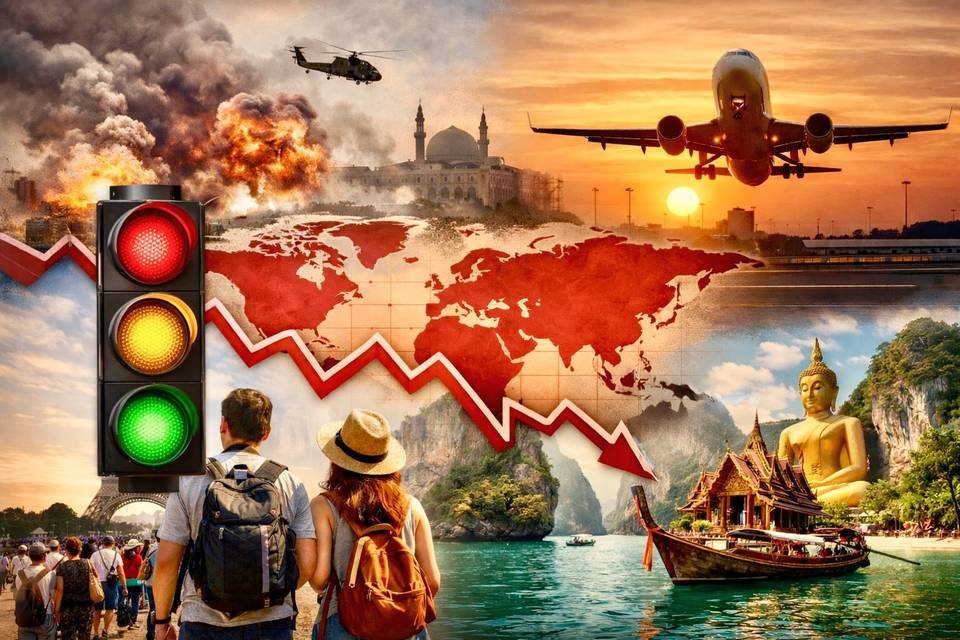
The breakdown of high-level peace negotiations in Islamabad has introduced a new layer of uncertainty into an already fragile global environment, with implications extending well beyond geopolitics into the core dynamics of international travel and tourism.
The talks, linked to efforts to de-escalate tensions surrounding the Iran conflict, were widely regarded as complex and inherently vulnerable. Reporting from Reuters characterised the initiative as high-risk, while analysis published by The New York Times highlighted the increasing susceptibility of diplomatic processes to rapid shifts in military and political conditions.
Their collapse underscores a broader trend: geopolitical instability is becoming more fluid, less predictable, and more immediately consequential for globally integrated industries—none more so than tourism.
Geopolitical Volatility and Systemic Exposure
Pakistan’s role as mediator was always constrained by external variables. As noted by security analyst Muhammad Faisal, the country had committed substantial political capital to the process, with limited capacity to influence outcomes shaped by larger strategic actors.
At the Stimson Center, Senior Fellow Elizabeth Threlkeld emphasised the structural fragility of the negotiations, describing them as taking place within a “high-risk environment” where disruption was a constant possibility. Similarly, geopolitical analyst Kamran Bokhari has warned that sustained tensions could amplify instability across interconnected regions spanning the Middle East and South Asia.
Coverage by The Guardian further reflects the growing influence of major power competition in shaping regional outcomes, limiting the effectiveness of traditional mediation frameworks.
For global business leaders, the message is clear: geopolitical risk is no longer episodic—it is structural.
Implications for Aviation and Travel Economics
The travel sector is uniquely exposed to geopolitical disruption due to its reliance on open borders, stable airspace, and predictable operating conditions.
Heightened tensions across the Middle East—one of the world’s most critical aviation corridors—raise the likelihood of airspace restrictions and rerouting. Such adjustments increase flight times and fuel consumption, placing upward pressure on operational costs at a time when energy markets are already volatile.
Rising oil prices, a typical by-product of regional instability, translate directly into higher airfares and reduced pricing flexibility. For airlines operating long-haul networks, particularly between Europe and Asia, even marginal increases in fuel costs can significantly affect route viability and capacity planning.
Recent analysis from Reuters indicates that tourism-dependent businesses in parts of Asia are already experiencing a slowdown in activity, reflecting the sector’s sensitivity to macro-level uncertainty.
Demand Dynamics: Behavioural Shifts Accelerate
Tourism demand is shaped as much by perception as by measurable risk. In the current environment, travellers—both leisure and corporate—are responding more rapidly to geopolitical signals than in previous cycles.
Insights from The New York Times suggest that decision-making timelines are shortening, with consumers delaying or reconfiguring travel plans in response to perceived instability. This is particularly evident in long-haul segments, where higher costs and greater perceived exposure amplify risk sensitivity.
A typical adjustment pattern is already emerging:
- Softening demand for intercontinental travel
- Increased preference for regional and short-haul journeys
- Greater emphasis on destinations perceived as politically stable and operationally reliable
For corporate travel, these shifts are compounded by budget scrutiny and risk management considerations, further moderating demand.
Asia-Pacific: Between Displacement Gains and Demand Constraints
The Asia-Pacific region occupies a pivotal position in this evolving landscape.
On one hand, it stands to benefit from displacement effects as travellers redirect away from perceived conflict zones. On the other, broader economic pressures—particularly those linked to energy costs and inflation—may dampen overall travel volumes.
Operationally, the sector faces additional complexities. Airlines may be required to reroute key services, insurers could reassess risk exposure, and tour operators may need to adjust offerings with limited lead time.
The duration of instability will be the defining variable. Short-term disruption can be absorbed; prolonged uncertainty risks structural demand erosion.
Thailand: Resilience Anchored in Positioning
Within this context, Thailand remains one of the region’s most strategically positioned tourism markets.
Supported by a diversified demand base—spanning domestic, regional, and international segments—the country has historically demonstrated resilience in the face of external shocks. The Tourism Authority of Thailand continues to emphasise safety, accessibility, and consistency of experience as core strengths.
Thailand’s geographic distance from current conflict zones, combined with its established global brand as a stable and welcoming destination, enhances its relative attractiveness in periods of uncertainty.
However, exposure to macroeconomic factors remains significant. Elevated airfares may constrain long-haul arrivals, while economic softness in key source markets could reduce discretionary spending.
At the same time, Thailand is well positioned to capture redirected demand, particularly from travellers prioritising stability and value.
Scenario Outlook: Strategic Planning Under Uncertainty
For industry stakeholders, scenario-based planning is increasingly essential.
Escalation Scenario
A deterioration in regional security leads to sustained increases in oil prices, widespread airspace disruption, and a marked contraction in global travel demand.
Prolonged Uncertainty Scenario
Tensions persist without full escalation. Demand becomes more cautious and price-sensitive, with a structural shift toward regional travel and shorter booking windows.
Stabilisation Scenario
Diplomatic engagement resumes, restoring a degree of predictability. Deferred demand re-enters the market, supporting a gradual recovery in long-haul and premium travel segments.
Conclusion: A Sector Defined by Confidence
The failure of the Islamabad talks represents more than a diplomatic setback; it is indicative of a broader recalibration in global risk.
For the travel and tourism sector, the challenge lies not only in managing operational impacts but in sustaining confidence—among travellers, investors, and industry partners.
In an environment where perception can shift as quickly as policy, resilience will depend on agility, clear communication, and the ability to adapt to rapidly changing conditions.
Tourism, by its nature, does not cease in times of uncertainty. It recalibrates.
The question for industry leaders is not whether disruption will occur, but how effectively they can navigate it.