
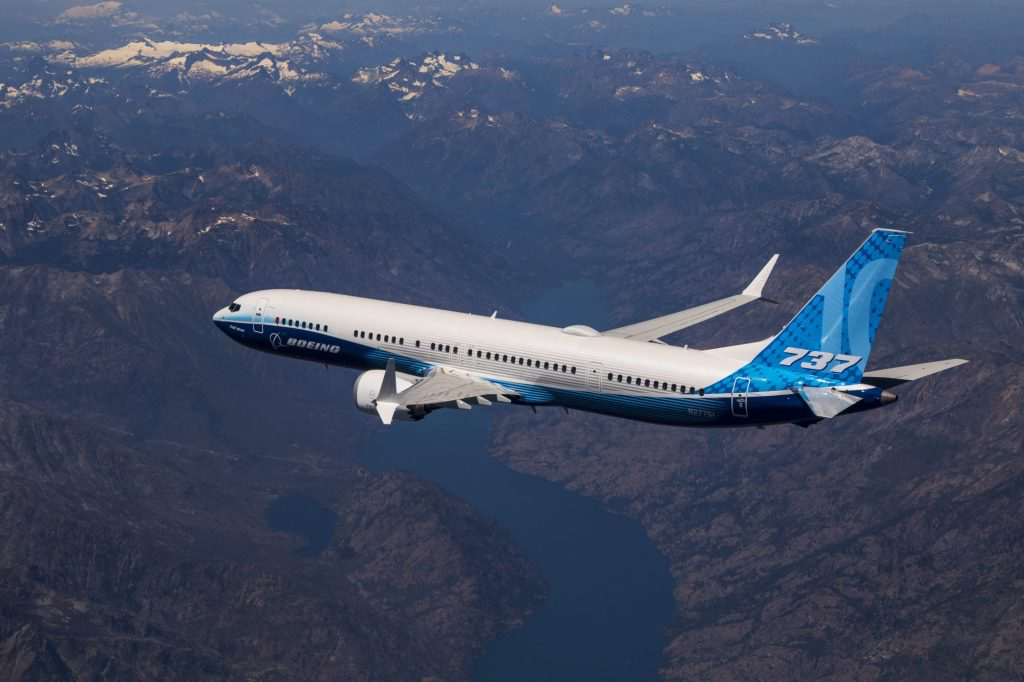
After years of delays and extensive safety reviews, Boeing’s largest 737 MAX variant has received US regulatory approval. The aircraft is expected to begin reaching airline customers in 2027, with WestJet among the carriers preparing to introduce it.
Boeing’s long-delayed 737 MAX 10 has reached a major milestone, receiving certification from the US Federal Aviation Administration (FAA) on 20 October 2026. The approval clears the way for the manufacturer to begin deliveries in the coming months, bringing the largest member of the 737 MAX family closer to commercial service after years of development and regulatory scrutiny.
Originally intended to enter service in 2020, the aircraft faced a prolonged certification process shaped by heightened safety requirements following the two fatal 737 MAX 8 crashes in 2018 and 2019, as well as renewed scrutiny of Boeing’s manufacturing practices after a door-plug incident involving a 737 MAX 9 in January 2024.
The FAA said the certification followed extensive reviews and required safety improvements, including an enhanced angle-of-attack system. The approval marks an important step for Boeing as it seeks to strengthen its position in the competitive single-aisle aircraft market.
Certification follows extensive testing
According to Boeing, the 737-10 certification programme involved nearly 1,000 test flights, more than 2,000 hours of flight testing and approximately 1,000 hours of ground testing. The process also included detailed design reviews, safety assessments and human-factors evaluations.
The aircraft is the first commercial aeroplane to be certified to the full extent of the requirements under the US Aircraft Certification, Safety, and Accountability Act of 2020, which strengthened oversight and documentation requirements for aircraft certification.
The FAA’s approval confirms that the aircraft’s design meets the applicable US certification requirements. Individual airlines must still prepare for delivery, complete operational preparations and introduce the aircraft into their schedules. International regulatory requirements may also affect when the aircraft enters service in different markets.
Capacity designed for busy short- and medium-haul routes
The 737 MAX 10 is designed to carry more passengers than the smaller members of Boeing’s MAX family, making it particularly relevant to airlines seeking additional capacity on busy domestic and regional routes.
Boeing lists a maximum capacity of 230 passengers, with a typical two-class configuration accommodating between 185 and 210 passengers. The aircraft has a published range of up to 3,100 nautical miles, or approximately 5,740 kilometres.
The manufacturer also says the aircraft can deliver a 20% reduction in fuel use and carbon dioxide emissions compared with the previous generation. Actual performance will depend on factors such as the aircraft being replaced, passenger load, route length and cabin configuration.
By carrying more passengers on each departure, airlines may be able to improve seat economics on high-demand routes, particularly at airports where limited take-off and landing slots make adding flights difficult. The financial benefit, however, depends on demand and the ability to fill the additional seats.
More than 1,500 aircraft on order
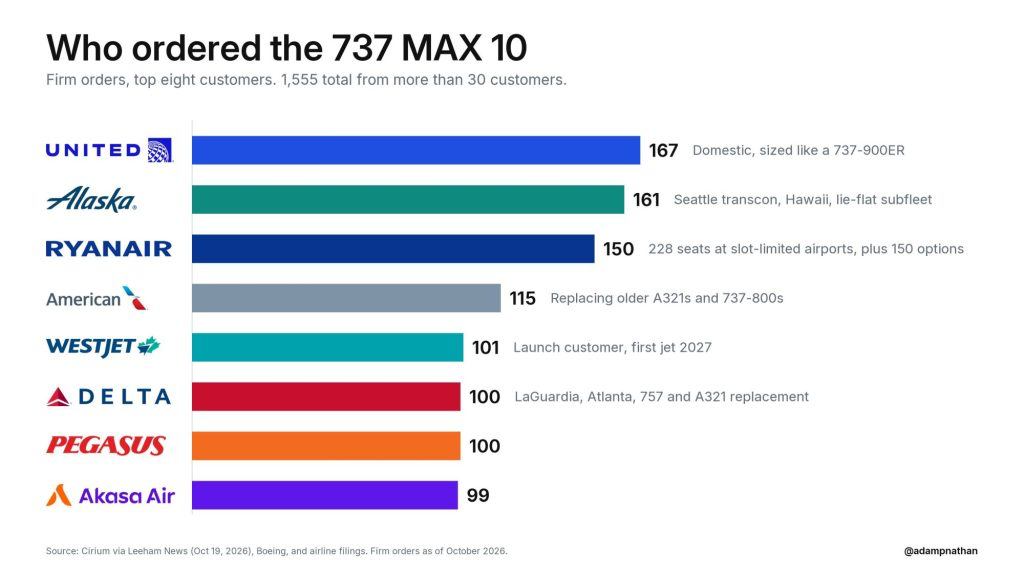
Boeing says it has received 1,555 orders for the 737-10 from more than 30 customers. The aircraft accounts for more than 30% of the 737 MAX programme’s current order book, making certification an important milestone for the manufacturer’s commercial aircraft business.
Major customers include United Airlines, Alaska Airlines, American Airlines and Delta Air Lines in the United States, as well as Ryanair in Europe and Pegasus Airlines in Türkiye.
The delivery schedules and cabin plans differ by airline, and many remain dependent on production, aircraft acceptance and operational readiness. The first deliveries are expected in 2027, with some international customers planning introductions later.
WestJet prepares for the first deliveries
Canada’s WestJet is among the airlines expected to receive the aircraft early in the delivery programme. The carrier is scheduled to take its first 737 MAX 10 through aircraft lessor Aviation Capital Group, with an initial delivery expected in early 2027. The lessor has agreements to supply 13 aircraft to WestJet.
For the Canadian airline, the aircraft is expected to support fleet renewal and additional capacity. The precise routes on which WestJet will deploy the MAX 10 will depend on its operational plans.
United, Alaska, American and Delta plan different cabin strategies
In the United States, the MAX 10 is expected to play a role in the fleet strategies of several major carriers.
United Airlines has placed a substantial order for the aircraft and previously planned to use it on some premium transcontinental services. Certification delays led the airline to make alternative fleet plans, including the use of Airbus A321neo aircraft on selected routes.
Alaska Airlines has outlined plans for a premium configuration on some MAX 10 aircraft, including its Aurora lie-flat suites for transcontinental services. The airline has indicated that the premium cabin rollout will follow the initial aircraft deliveries, with the suites planned for 2028.
American Airlines has also ordered the aircraft as part of its wider fleet renewal and premium-seat strategy. Delta Air Lines plans to deploy its MAX 10s across several major hubs, with cabin layouts intended to include a significant premium seating component.
These plans underline how airlines intend to use the aircraft not only to increase capacity but also to refine their cabin products. Final configurations and routes will be confirmed by each airline as delivery approaches.
Ryanair and Pegasus target high-capacity operations
European low-cost carrier Ryanair has committed to 150 aircraft, with options for a further 150, according to the supplied order details. Its planned high-density configuration is designed to maximise passenger capacity on routes with strong demand.
Türkiye-based Pegasus Airlines has also ordered the aircraft, with deliveries expected to begin later than those planned by some North American customers.
For low-cost airlines, the larger cabin offers the potential to distribute operating costs across more seats on each flight. The commercial outcome will depend on passenger demand, aircraft utilisation and the cost of operating the service.
A lengthy programme shaped by safety scrutiny
Boeing launched the 737 MAX 10 in 2017 to compete in the larger single-aisle market, where Airbus’s A321neo has established a strong position. The MAX 10’s original entry-into-service target was subsequently pushed back as the aircraft underwent additional engineering work and regulatory assessment.
The two fatal MAX 8 crashes in 2018 and 2019 resulted in the global grounding of the 737 MAX fleet and prompted extensive investigations into the aircraft’s design and certification. The US Congress later introduced more stringent certification requirements, increasing the level of documentation and human-factors evaluation expected from manufacturers.
Further technical concerns, including the engine anti-ice system and the broader scrutiny of Boeing’s production quality after the January 2024 MAX 9 incident, added to the pressure surrounding the programme.
The latest approval follows the completion of testing and the required design changes. The FAA has said it will continue to oversee Boeing’s production and safety standards as deliveries begin.
What the aircraft means for travellers
For passengers, the introduction of the 737 MAX 10 is likely to be gradual. Airlines must accept the aircraft, complete cabin and operational preparations, train staff where required and assign the aircraft to routes before it appears in passenger schedules.
The aircraft’s additional capacity could support more seats on popular domestic and regional services, but the passenger experience will vary by airline. Seat pitch, premium seating, inflight entertainment, charging facilities and connectivity will depend on each carrier’s cabin specification.
The MAX 10’s certification is a significant development for Boeing and its airline customers, but it is not the end of the process. The next milestones will be the start of deliveries, the introduction of the aircraft into airline fleets and its performance in regular commercial operations.