
Industry roadmap underscores urgency of scaling sustainable fuels, technology innovation and coordinated policy support
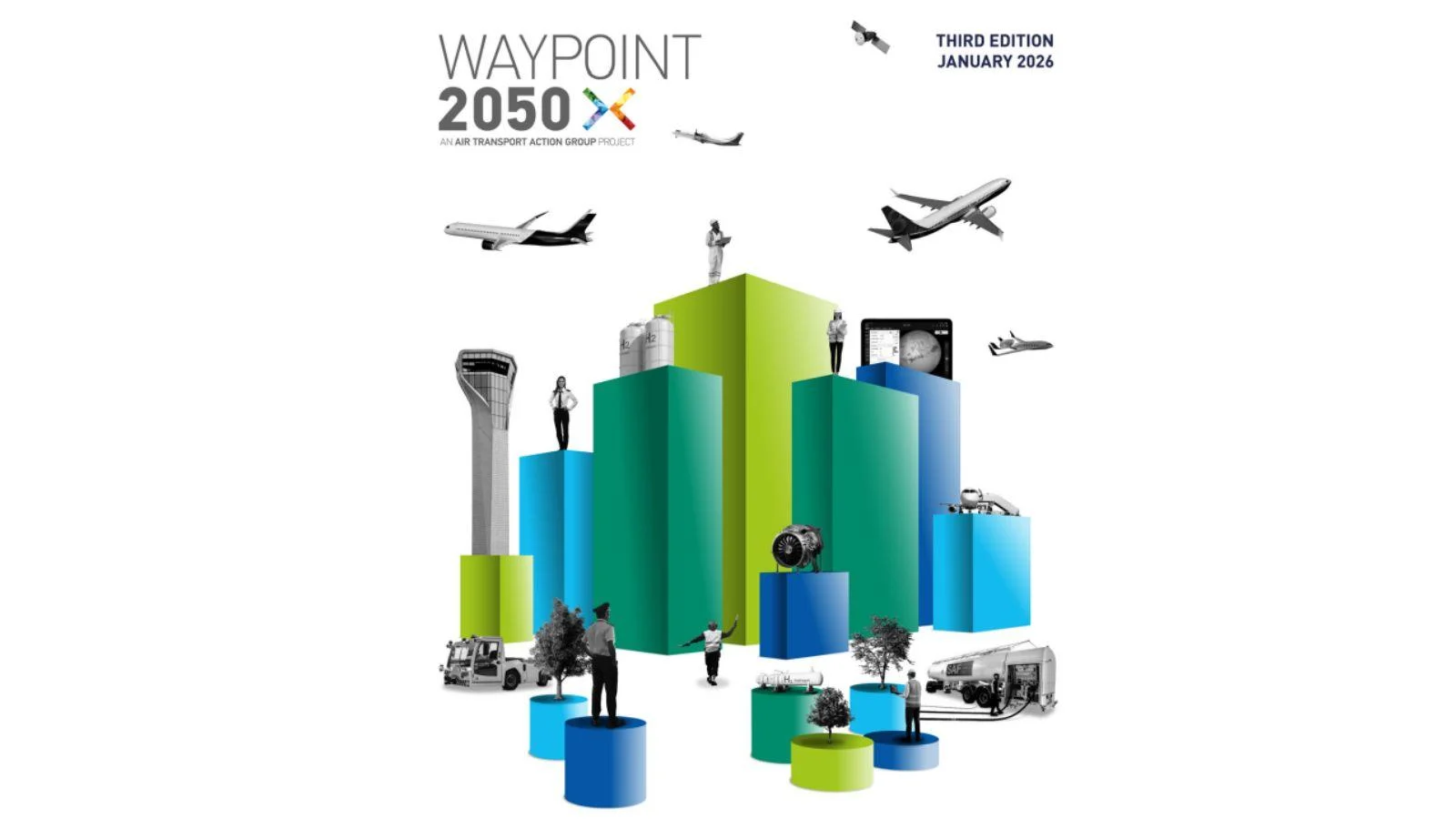
The global aviation industry can still achieve its ambition of net-zero carbon emissions by 2050, but the coming five years will be decisive in determining whether that goal remains viable. That was the central message emerging from the latest Waypoint 2050 analysis presented by the Air Transport Action Group (ATAG) during the Singapore Airshow, where industry leaders, policymakers and technology stakeholders gathered to assess the sector’s decarbonisation trajectory.
The updated outlook reaffirms that net-zero aviation remains technically and economically possible. However, it stresses that the pace of action must accelerate significantly before the end of the decade to avoid higher transition costs and more disruptive structural adjustments later on. The responsibility extends beyond airlines to include governments, energy producers, financial institutions, aircraft manufacturers and infrastructure operators.
Two Pathways to 2050
The Waypoint 2050 framework outlines two illustrative pathways reflecting different balances of technology, fuel transition and policy support.
One pathway places sustainable aviation fuel (SAF) at the core of emissions reduction. In this scenario, SAF becomes the dominant lever, supported by operational efficiencies and market-based measures. To meet 2050 goals under this model, global SAF demand would need to scale dramatically, reaching several hundred million tonnes annually — a level that requires unprecedented expansion in production capacity, feedstock supply chains and supportive policy frameworks.
The alternative pathway envisages a more technology-led transition. Earlier deployment of advanced aircraft concepts — including hybrid-electric, fully electric and, in the longer term, hydrogen-powered aircraft — plays a larger role. Even in this scenario, SAF remains critical, providing flexibility as new technologies mature and allowing the sector to manage uncertainties related to cost, infrastructure and certification timelines.
Progress, But Not at Required Speed
The industry has made measurable progress. A growing share of the global fleet now consists of next-generation aircraft offering improved fuel efficiency. Airports and air navigation service providers are also implementing infrastructure upgrades and operational reforms aimed at reducing fuel burn and emissions.
However, current deployment levels of SAF and breakthrough technologies fall short of what is required to maintain a smooth trajectory to 2050. Supply chain bottlenecks, financing constraints and geopolitical uncertainties continue to affect the pace of scale-up.
SAF as a Cornerstone
Across all decarbonisation scenarios, SAF emerges as the single largest contributor to emissions reduction. Production volumes have risen in recent years, but scaling to the levels envisioned for 2050 will demand sustained policy incentives, long-term offtake agreements and capital flows into refining capacity.
Even with aggressive SAF adoption and technological improvements, residual emissions are expected to remain. As a result, market-based measures and high-quality carbon removals form an integral part of the long-term transition strategy.
The 2030 Milestone
The period to 2030 is identified as a critical inflection point. Priority actions include accelerating SAF production, speeding up the replacement of older aircraft with more fuel-efficient models, modernising air traffic management systems and maintaining global alignment on carbon market mechanisms such as CORSIA. Investment in credible carbon removal solutions will also become increasingly important as the sector moves toward deep decarbonisation.
Growth and Responsibility
Aviation demand is projected to continue rising over the coming decades, reflecting the sector’s role in global trade, connectivity and economic development. The challenge, therefore, lies in decoupling that growth from emissions through technology, fuel innovation and systemic efficiency gains.
Industry leaders emphasise that the energy transition in aviation is not solely an environmental imperative but also an economic one, shaping future investment flows, job creation and the long-term competitiveness of the sector.
A Narrowing Window
The overarching conclusion is clear: delay increases both cost and complexity. Long-term policy certainty, coordinated international action and cross-sector collaboration are essential to ensure that aviation remains on a credible path to net zero. The next five years will determine whether the industry can maintain momentum or face a steeper, more disruptive transition later.