
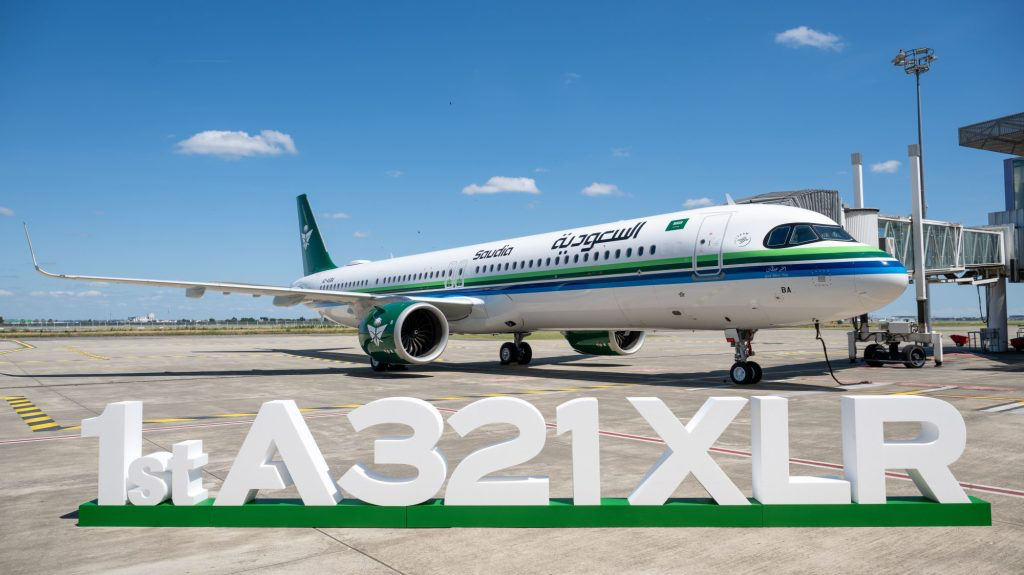
Saudia has officially joined the growing list of global airlines operating the next-generation Airbus A321XLR after taking delivery of its first aircraft from Airbus in Toulouse and ferrying it to its operational base in Jeddah on May 24.
The delivery marks a significant milestone in the airline’s long-haul growth strategy, with the Saudi Arabian flag carrier planning to deploy the aircraft on premium-focused international routes that require extended range but do not justify the economics of larger wide-body aircraft.
Saudia becomes the world’s eighth operator of the Airbus A321XLR and is expected to receive a total of 15 aircraft as part of its fleet modernisation and network expansion programme aligned with the Kingdom’s Vision 2030 aviation and tourism ambitions.
A Strategic Shift Toward Premium Narrow-Body Operations
The arrival of the A321XLR introduces a new operational model for Saudia, enabling the airline to serve thinner long-haul routes while maintaining a strong premium offering.
The aircraft features a dual-class cabin configuration with 24 business class seats and 144 economy class seats, making Saudia the highest business-class-density operator of the A321XLR globally.
By comparison, American Airlines has configured its A321XLR aircraft with 20 premium seats, while Aer Lingusoffers 16 business class seats on the same aircraft type.
Industry analysts believe Saudia’s premium-heavy layout reflects the airline’s confidence in growing demand for high-yield business and leisure travel across medium- and long-haul sectors connecting Saudi Arabia with Europe, Africa, and Asia.
The aircraft has been fitted with the VantageSOLO business class product in a 1-1 configuration, ensuring every passenger receives direct aisle access and enhanced privacy through sliding doors — a feature increasingly associated with premium long-haul travel experiences.
In economy class, the aircraft is equipped with Safran Z400 seats featuring 13-inch inflight entertainment screens designed to improve passenger comfort on longer sectors.
Balancing Long-Haul Comfort on a Single-Aisle Aircraft
While the Airbus A321XLR has been widely praised for its operational efficiency and extended range capabilities, airlines globally continue evaluating how passengers adapt to long-haul journeys aboard single-aisle aircraft traditionally associated with shorter flights.
As more carriers introduce the aircraft into service, operational challenges such as lavatory access, inflight catering flow, crew rest arrangements, and onboard service logistics are becoming important considerations for airlines operating sectors approaching 10 to 11 hours.
Despite these considerations, aviation experts view the aircraft as one of the industry’s most transformative developments, allowing airlines to economically open routes that previously required significantly larger and more expensive wide-body aircraft.
New Long-Haul Routes from Jeddah
According to Airbus specifications, the A321XLR offers a range of up to 4,700 nautical miles — approximately 11 hours of flight time — enabling direct connectivity from Jeddah to large parts of Europe, Africa, the Indian subcontinent, and select leisure markets.
Saudia has confirmed that its first A321XLR services will launch from June 3, initially operating routes between Jeddah and several major international destinations.
The initial network includes:
- Madrid
- Paris
- Vienna
- Geneva
- Maldives
The airline also indicated that future A321XLR destinations are expected to include:
- Barcelona
- Brussels
- Milan
- Rome
- Dakar
Industry observers note that these routes represent markets where premium demand exists but passenger volumes may not yet support larger aircraft such as the Boeing 787 or Airbus A330 on a year-round basis.
Airlines Worldwide Embrace the Airbus A321XLR
Saudia joins a rapidly expanding group of airlines using the A321XLR for a wide range of operational strategies.
Iberia, the launch customer for the aircraft, has deployed the type on routes from Madrid to destinations including Boston, Washington Dulles, San Juan, Recife, and Fortaleza.
American Airlines has initially focused on premium transcontinental services such as New York–Los Angeles and Boston–Los Angeles before expanding into transatlantic markets including New York–Edinburgh.
IndiGo has used the aircraft to explore ultra-long narrow-body operations, including the Delhi–Istanbul sector, currently regarded as one of the longest A321XLR services globally at over 10 hours.
Meanwhile, Wizz Air has deployed the aircraft on extended European and Middle Eastern routes, while Qantas has utilised the type for both domestic Australian operations and international services such as Brisbane–Manila.
Air Canada has also begun integrating the aircraft into both domestic and transatlantic operations from hubs including Montreal and Toronto.
The growing adoption of the aircraft highlights a broader industry trend toward using long-range narrow-body jets to increase frequency, lower operational risk, and open new city pairs previously considered commercially unviable.
Fleet Growth Supports Saudi Vision 2030
Saudia currently operates a fleet of 172 aircraft serving more than 100 destinations globally.
Its fleet includes:
- 65 Airbus A320 Family aircraft
- 39 Airbus A330 aircraft
- 43 Boeing 777 aircraft
- 21 Boeing 787 Dreamliners
The introduction of the A321XLR forms part of the airline’s broader fleet and network expansion strategy as Saudi Arabia accelerates aviation, tourism, and infrastructure development under Vision 2030.
Industry experts believe the aircraft offers Saudia a flexible and lower-risk platform for testing new premium routes, increasing international connectivity, and expanding tourism flows into the Kingdom without the financial exposure associated with deploying larger wide-body aircraft on emerging markets.
As airlines worldwide continue redefining long-haul travel using next-generation narrow-body aircraft, the success of Saudia’s premium-heavy A321XLR strategy may offer valuable insight into the future economics and passenger acceptance of long-haul single-aisle operations.