
Greece is looking to build on its position as one of Europe’s leading cruise destinations as passenger demand continues to grow, Piraeus records new traffic milestones and cruise lines accelerate investment in lower-emission ships and environmental technologies.
The country, however, faces a more complex challenge than simply attracting more cruise calls. Industry representatives say Greece needs predictable regulations, competitive operating conditions, modern port infrastructure and a coordinated national strategy capable of expanding cruise tourism beyond its established gateways.
The issue was highlighted at the International Maritime Transport Conference in Thessaloniki, where representatives of the Cruise Lines International Association (CLIA), MSC Cruises Greece and Greek ports discussed the future of cruise tourism, infrastructure and the transition towards cleaner shipping. The conference programme confirms the participation of Maria Deligianni, CLIA’s Regional Director for the Eastern Mediterranean, and Kyriakos Anastassiadis, Strategic Advisor to MSC Cruises Greece, among other industry and port executives.
At the same time, new data from CLIA show that cruise operators are rapidly expanding the use of shore power, multi-fuel engines and other environmental technologies. The figures underline a growing gap between investment on board ships and the availability of compatible infrastructure at ports.
Piraeus strengthens its position as a Mediterranean cruise hub
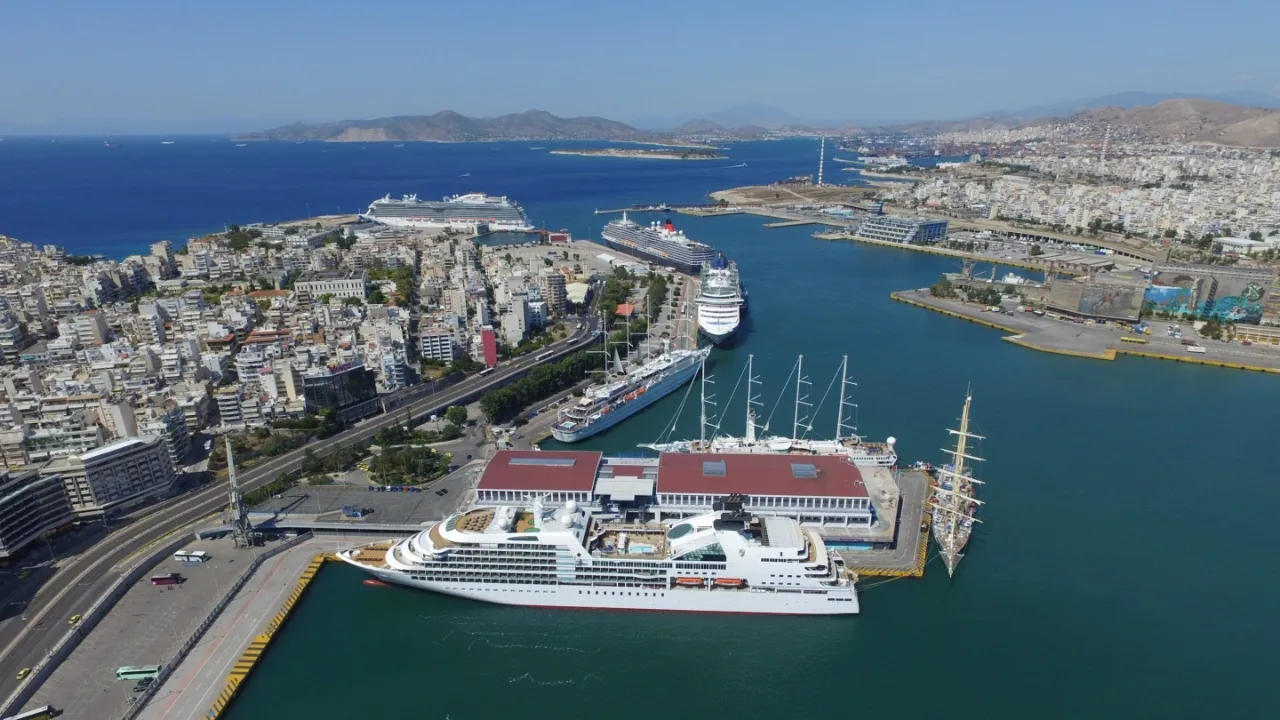
The scale of Greece’s cruise business is particularly visible at Piraeus.
The Port of Piraeus welcomed approximately 1.85 million cruise passengers and 863 cruise ships in 2025, according to the Piraeus Port Authority (PPA). The figure represented a new passenger record for the port and reinforced Piraeus’ position as a major cruise destination in the Eastern Mediterranean.
The port authority said its strategic location, combined with continuing investment in infrastructure and services, is supporting the development of cruise activity. The 2026 season began with calls by ships including Viking Vesta and MSC Lirica, with both cruise operators maintaining scheduled calls at the port during the year.
Piraeus also benefits from its direct connection with Athens. Cruise passengers can reach the Acropolis, archaeological sites, museums, restaurants, shopping districts and the wider Attica region, while the port also functions as a gateway to nearby islands.
The economic impact extends beyond the port itself, supporting transport operators, excursion providers, restaurants, retailers, cultural attractions and other tourism businesses.
Piraeus’ development also reflects the broader transformation of the port into a multifunctional maritime hub, combining cruise activity with container and vehicle handling, coastal shipping, shipbuilding and repair and other port services.
The next phase is increasingly focused on digitalisation and the environmental transition, including energy efficiency, renewable energy and shore-side electrification.
Greece seeks greater predictability for cruise operators
While Piraeus is expanding, cruise executives are calling for greater certainty over the costs and rules governing operations in Greece.
Maria Deligianni, CLIA’s Regional Director for the Eastern Mediterranean, has stressed the importance of a stable and predictable operating environment, noting that cruise itineraries and commercial strategies are planned well in advance.
According to comments attributed to Deligianni, changes to port fees and other financial charges should be subject to consultation 18 to 24 months before implementation, with final decisions made at least 12 months ahead. The objective is to give cruise companies enough time to incorporate new costs into itineraries and pricing.
The concern is particularly relevant because cruise packages can be priced and sold long before a ship reaches a Greek port. A charge introduced after fares have been established can therefore become an additional operating cost for the cruise company rather than something that can immediately be passed on to passengers.
Deligianni has also pointed to the impact of Greece’s cruise-related charges, saying that in some circumstances the additional cost for a family of four can reach €200.
From established gateways to a wider network of ports
Greece’s cruise strategy is also facing a geographic question: how to distribute traffic more widely across the country.
Anastasiadis has argued that the country needs a comprehensive national cruise strategy rather than focusing only on individual taxes or port charges. One issue is whether part of the revenue generated by cruise tourism can be channelled back into ports and destinations through infrastructure investment, promotion and incentives for new cruise calls.
The objective would be to expand cruise activity beyond the country’s most established ports.
The discussion is particularly relevant for destinations such as Thessaloniki and Kavala, which have the potential to attract more cruise calls but face different commercial and geographical considerations.
For Thessaloniki, for example, the additional sailing distance from established Western Mediterranean itineraries can translate into extra time and fuel consumption for cruise operators. Temporary incentives for new routes could therefore be considered as part of a broader strategy to help emerging destinations establish themselves on cruise itineraries.
The concept would represent a shift from simply collecting revenue from established cruise destinations towards using part of that revenue to develop the wider cruise network.
Greece remains a major European cruise market
Despite the challenges, Greece remains one of Europe’s largest cruise destinations.
CLIA figures cited in recent industry discussions place Greece third in Europe behind Italy and Spain, with approximately 6,000 cruise-ship calls and more than 8 million passenger visits annually.
CLIA’s wider European impact data also underline the economic significance of cruise tourism to Greece. Its 2024 analysis recorded 7.93 million total cruise visits in Greece, including transit, embarkation and debarkation activity, and €1.67 billion in total cruise-related spending across passenger and crew expenditure, cruise-line purchases, ship and capacity-building and staff wages.
The global market is expanding at the same time. CLIA recorded 37.2 million ocean-cruise passengers in 2025 and forecasts 38.3 million in 2026, an increase of approximately 4%.
That continued expansion provides an opportunity for Greece, but also increases the pressure on ports and destinations to manage visitor flows, infrastructure and environmental impacts.
Cruise ships are becoming more technologically advanced
The environmental transition is adding another layer to the challenge.
CLIA’s latest Environmental Technologies and Practices Report shows that cruise operators are investing in more efficient vessels, multi-fuel engines, shore power capability and advanced wastewater and water-production systems.
The number of CLIA-member cruise ships capable of connecting to shore power has increased from 55 in 2018 to 193 today, representing about 65% of reporting ships and 72.5% of reporting capacity. CLIA projects that 279 ships could have shore-power capability by 2039.
Shore power allows a ship to connect to the electricity grid while in port and switch off its onboard engines, potentially reducing emissions at berth depending on the electricity source and operating conditions.
The infrastructure available at ports, however, remains significantly more limited.
CLIA currently identifies 40 cruise ports worldwide with at least one berth offering shore-power capability — fewer than 3% of ports visited by cruise ships.
The imbalance illustrates one of the central challenges facing the industry’s transition: investment in new ships needs to be accompanied by investment in ports, electricity networks and energy supply.
For Greece, the issue is particularly relevant as European requirements drive the development of alternative-fuel and shore-side infrastructure at major ports.
Multi-fuel ships are entering the fleet
Cruise lines are also expanding their ability to operate vessels using different fuel types.
CLIA data show that the number of member cruise ships with multi-fuel engines has increased from one vessel in 2018 to 30 today. Based on the current order book, the figure is expected to reach 56 by 2030 and 69 by 2039.
CLIA Executive Chairman and CEO Bud Darr has said cruise companies are continuing to invest in technologies, fuels and operational capabilities intended to improve efficiency and prepare ships for future energy options.
The industry, however, also points to the need for governments, ports, fuel producers and energy providers to make lower- and near-zero-emission fuels available at sufficient scale.
Heavy fuel oil use continues to decline
The changing fuel mix provides another indication of the industry’s technological transition.
According to data reported by cruise passenger ships to the International Maritime Organization, heavy fuel oil accounted for 74.2% of reported cruise fuel use in 2019. By 2024, that share had fallen to 60.6%.
Over the same period, the combined share of non-HFO fuels rose from 25.8% to 39.4%. CLIA’s own tracking put the share of non-HFO fuel use among member cruise lines at 40.3% in 2025.
European data also indicate improvements in efficiency. Analysis of information reported to the European Maritime Safety Agency through the EU THETIS-MRV system shows that average fuel consumption per reporting cruise ship fell by approximately 18.5% between 2018 and 2025, while average CO₂ emissions per ship declined by approximately 19.4%.
These figures do not mean that the cruise fleet has completed its transition. Rather, they show a gradual change in fuel use and operational efficiency alongside continued investment in new technologies.
Water and wastewater are part of the sustainability equation
The environmental challenge extends beyond fuel and carbon emissions.
Water management is particularly relevant for Greece, where several island destinations face pressure on freshwater resources during the peak tourist season.
CLIA’s latest data show that 293 cruise ships can produce freshwater onboard, while 218 are theoretically capable of producing enough freshwater to meet all their needs without replenishment at destinations.
Wastewater treatment has also expanded. Advanced wastewater treatment systems are now installed on 249 ships, compared with 136 in 2018.
For destinations such as the Greek islands, the implications extend beyond the vessels themselves. Port reception facilities, recycling systems, waste management, electricity networks and water infrastructure all form part of the sustainability equation.
Piraeus and the next phase of Greek cruise tourism
Piraeus’ 2025 passenger record demonstrates the scale of demand already flowing through Greece’s largest port. At the same time, the industry’s technological transition is changing the infrastructure requirements that ports must meet.
For Greece, the next stage of cruise development is therefore likely to involve several interconnected priorities: maintaining competitiveness, providing greater regulatory predictability, expanding cruise activity to additional ports, investing in shore-side infrastructure and ensuring that environmental improvements made onboard ships are matched by facilities on land.
The growth of Piraeus provides a strong example of the economic potential of cruise tourism. The wider national challenge is to translate that momentum into a more geographically diversified network of destinations while managing costs, infrastructure requirements and environmental pressures.
As cruise passenger numbers continue to rise globally and the fleet becomes increasingly equipped for alternative fuels and shore power, Greece’s cruise strategy will increasingly depend not only on how many ships it can attract, but on how effectively its ports and destinations can prepare for the industry’s next phase.