
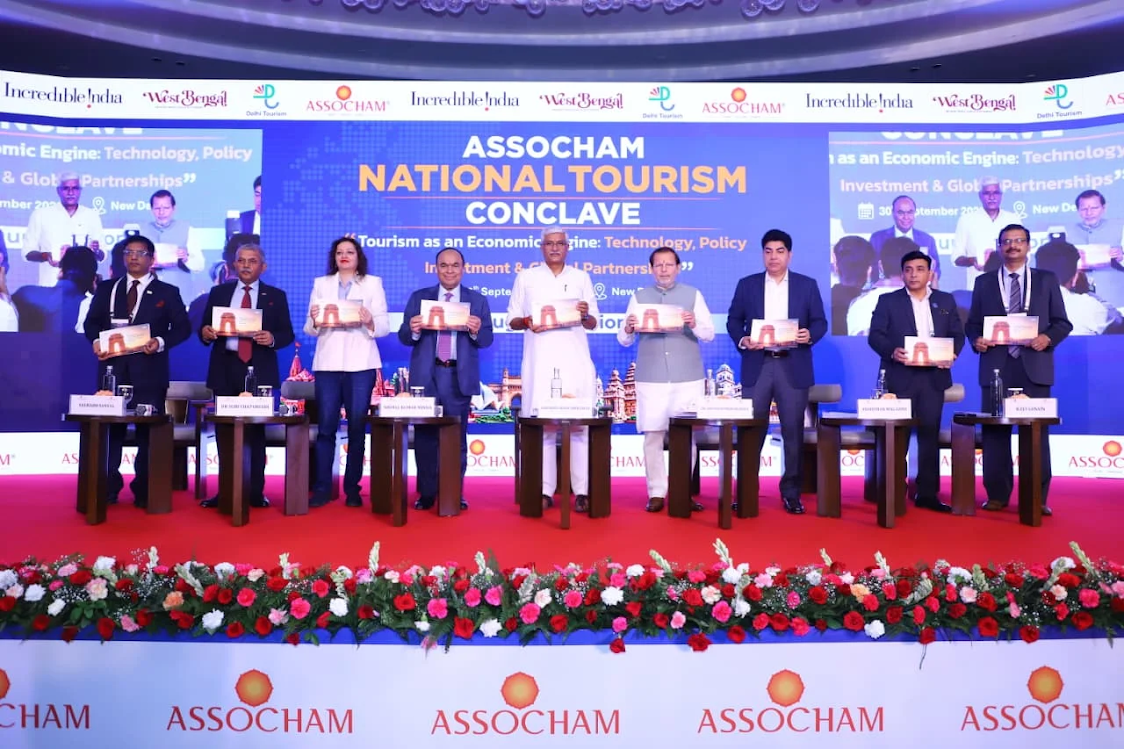
Greater private-sector investment, new destination development and a stronger focus on destination management and visitor experience are emerging as key priorities for the next phase of India’s tourism growth, according to discussions at the ASSOCHAM National Tourism Conclave 2026 in New Delhi.
The conclave, held under the theme “Tourism as an Economic Engine: Technology, Policy, Investment & Global Partnerships,” brings together government representatives, tourism boards, hospitality companies, travel-tech firms, investors, destination marketers, academics and other industry stakeholders to examine the opportunities and challenges shaping India’s tourism sector. ASSOCHAM lists the event for 30 September 2026 at Hotel Shangri-La Eros, New Delhi, while CBRE India is participating as knowledge partner.
Discussions centre on connectivity and destination infrastructure, investment facilitation, ease of travel, technology adoption, skills development, destination creation and closer coordination between government and industry.
Private investment seen as critical to tourism expansion
Gajendra Singh Shekhawat, Minister of Tourism and Culture, Government of India, emphasised the need for greater private-sector participation as India seeks to expand its tourism capacity and develop new destinations.
“Tourism is emerging as an important driver of economic growth and employment, with the potential to play a much larger role in India’s journey towards Viksit Bharat 2047,” Shekhawat said.
He noted that improving connectivity through highways, airports, railways and new transport corridors is expected to support further growth in travel demand. The next stage, he said, would require investment not only in established tourism centres but also in new destinations, experiences, infrastructure, hospitality and human resources.
The minister also highlighted destination management and visitor experience as increasingly important elements of tourism development.
“Technology will also be central to improving the tourism experience, from destination discovery and parking to feedback and visitor services,” he said, adding that partnerships between government, technology companies, airlines and other private-sector stakeholders would remain important.
Tourism demand broadens across multiple segments
The conclave also examined the changing composition of India’s tourism demand, with opportunities extending beyond traditional leisure travel.
According to the material presented at the event, the ASSOCHAM-CBRE report identifies potential across spiritual tourism, MICE and destination events, wellness and medical tourism, cruise travel, rural tourism and wildlife experiences.
Improving connectivity—including expressways, rail networks, ropeways and river-based circuits—is also opening opportunities for destinations outside India’s established tourism centres.
The broader investment opportunity extends beyond hotels, with demand expected across transportation, attractions, food and beverage, retail, local enterprises and other components of the visitor economy.
ASSOCHAM calls for a competitive and sustainable tourism ecosystem
Nirmal K. Minda, President, ASSOCHAM, said tourism was increasingly moving beyond its traditional role as a leisure activity to become an important contributor to economic growth, employment, investment and regional development.
“India’s tourism sector is at a defining juncture, evolving beyond leisure into a powerful engine of economic growth, employment, investment and regional development,” Minda said.
He highlighted spiritual, MICE, wellness, cruise, rural and wildlife tourism as areas with potential for further investment, while pointing to the importance of connectivity and emerging destinations.
Minda also outlined ASSOCHAM’s focus on Make in India, Ease of Doing Business, MSME growth, the Digital Economy and Sustainability, saying continued government-industry dialogue would be important to translating tourism opportunities into investment and policy initiatives.
Technology and AI reshape destination discovery
Technology emerged as another central theme, particularly in relation to destination discovery, navigation, visitor services and destination management.
Dr Subi Chaturvedi, Former Member, MAG, United Nations Internet Governance Forum, said technology and artificial intelligence could help broaden the distribution of tourism demand by bringing lesser-known destinations, communities and local businesses to the attention of travellers.
She highlighted opportunities for local guides, artisans, women entrepreneurs, homestays and small businesses to participate more directly in the tourism economy.
“The real measure of smart tourism is not impressions or footfall alone,” Chaturvedi said. “It is whether every new journey creates shared value, supports local livelihoods and protects the heritage and character of the places people come to experience.”
Her comments underscored the growing focus on using digital tools not simply to attract visitors, but to distribute tourism activity and economic benefits more widely.
Haryana highlights regional tourism potential
Dr Arvind Kumar Sharma, Cabinet Minister for Cooperation, Jails, Elections, Heritage and Tourism, Government of Haryana, highlighted the potential for tourism to support economic opportunities for farmers, workers, MSMEs, entrepreneurs and local communities.
He pointed to Haryana’s proximity to the National Capital Region and its heritage and cultural assets as potential drivers of tourism-led development.
Destinations including Kurukshetra, Panipat and Surajkund, along with opportunities in rural tourism, were highlighted as areas where further investment and public-private partnerships could support tourism development.
Sharma also called for greater industry participation and investment in tourism properties and destinations across the state.
Infrastructure and destination management remain priorities
Anshuman Magazine, Chairman & CEO, India, South East Asia, Middle East and Africa, CBRE, said India’s diverse tourism proposition—including heritage, spirituality, culture, wildlife, wellness, beaches and mountains—provides a broad base for future development.
He emphasised the importance of infrastructure, destination management, cleanliness and safety, alongside the use of technology and artificial intelligence to create more seamless visitor experiences.
Greater collaboration between government and private-sector stakeholders, he said, could support employment creation and regional economic development.
CBRE’s participation as knowledge partner reflects the growing intersection between tourism, hospitality and investment. The company’s broader 2026 research has also identified infrastructure improvements and experience-led hospitality as important factors influencing tourism and hospitality development across emerging Indian destinations.
Travel trade and local businesses remain central
Ravi Gosain, President, IATO, highlighted the wider economic footprint of tourism, pointing to its links with transport, hospitality, local businesses, artisans, guides and communities.
He said India’s cultural heritage, nature, spirituality, wildlife and cuisine provide a strong foundation for developing distinctive tourism experiences, while technology and AI can help make travel planning more personalised and improve how tourism businesses reach prospective visitors.
He also stressed the need for continued investment in connectivity, digital infrastructure, skills and lesser-known destinations.
Investment opportunity extends beyond traditional tourism centres
The discussions at the conclave point to a tourism development model in which investment is increasingly distributed across the wider visitor economy.
Spiritual destinations, MICE hubs, wellness centres, cruise circuits, rural communities and wildlife destinations can create demand for hotels and accommodation, but also for transportation, attractions, food and beverage, retail, guides, digital services and local enterprises.
The emphasis on destination management also reflects a shift from measuring tourism primarily through visitor numbers towards improving the quality and sustainability of the visitor experience.
With government policy, private investment, technology and local participation increasingly interconnected, the conclave’s discussions placed collaboration between the public and private sectors at the centre of India’s tourism development agenda.