
Artificial intelligence is no longer just a buzzword in the travel industry. It’s becoming a practical tool that helps tourism businesses work more efficiently, reduce operating costs and increase revenue.
As travel demand continues to recover, many tourism companies are facing a different challenge. Bookings are growing, but so are operating costs. Managing suppliers, coordinating bookings, handling customer requests and keeping everything running smoothly has become more complex than ever.
This is where AI is making a real difference. Instead of replacing people, it’s helping teams automate repetitive tasks, reduce costly mistakes and improve the overall customer experience.
Why Operations Matter More Than Ever
A customer booking a holiday package may seem like a simple transaction. Behind the scenes, however, there’s a long list of tasks.
Hotels need to confirm room availability. Airport transfers must be arranged. Tour guides have to be assigned. Itineraries need updating, and customers expect quick confirmations and timely travel information.
Many travel companies still manage these tasks through emails, spreadsheets and messaging apps. As booking volumes increase, so does the workload, making it harder for operations teams to keep up.
Industry research shows that companies with manual processes often spend significantly more on operational coordination than businesses using automated workflows. That difference directly affects profitability.
Smarter Workflows, Lower Costs
One of AI’s biggest advantages is reducing repetitive administrative work.
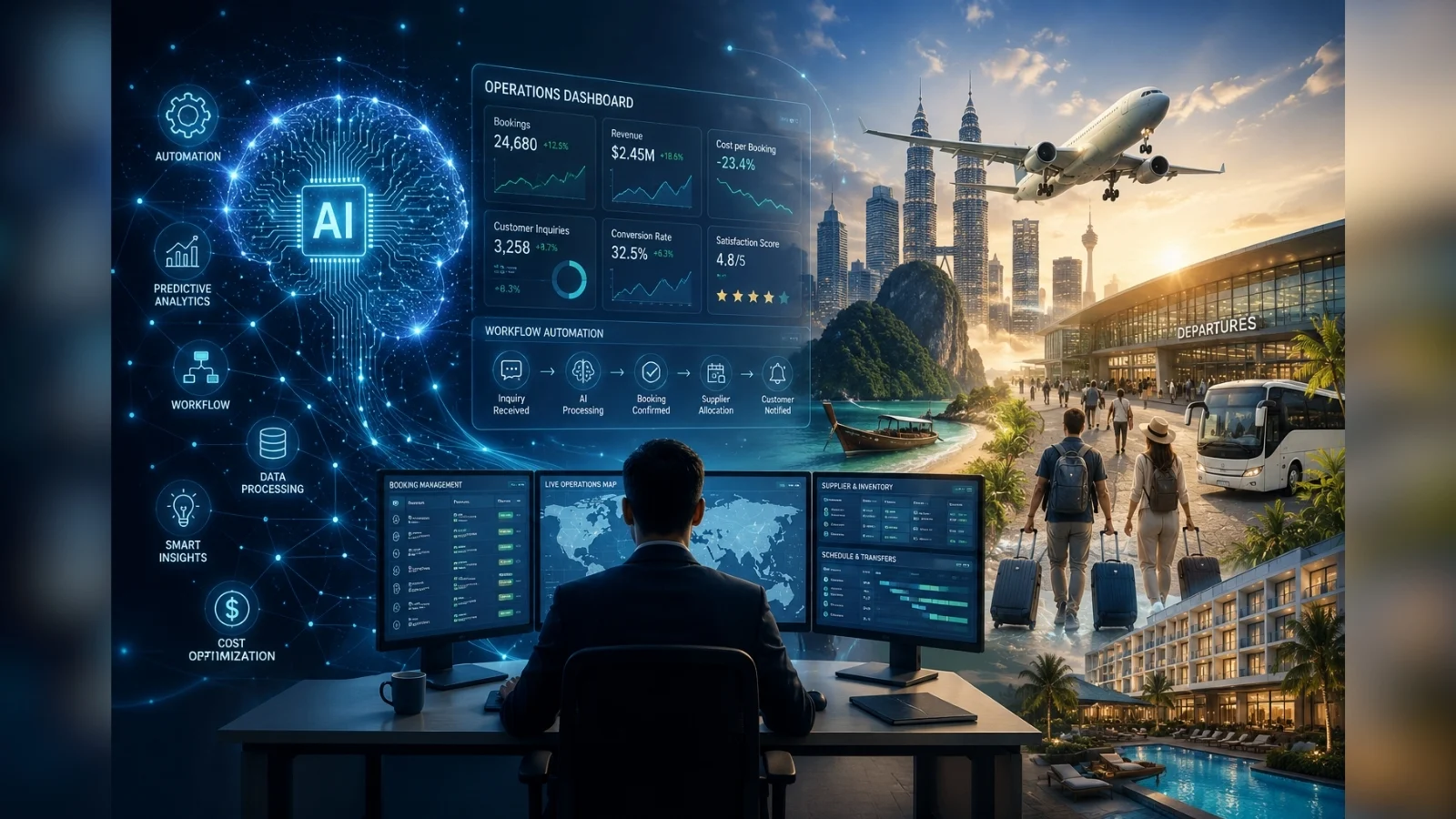
Modern AI-powered systems can automatically monitor bookings, assign tasks, generate supplier requests, prepare travel documents and send customer updates. Instead of employees spending hours following up on routine tasks, they can focus on solving exceptions and improving service.
Many businesses using these systems report handling more bookings without increasing staff numbers.
Fewer Booking Errors
Booking mistakes can be expensive.
Incorrect hotel reservations, wrong transfer dates or mismatched room types not only create extra work but can also damage customer trust.
AI can compare booking details with supplier confirmations in real time, identifying problems before they affect travellers.
Several travel companies have reported significant reductions in booking conflicts after introducing automated validation systems, allowing operations teams to focus on improving service rather than fixing mistakes.
Faster Responses Lead to More Bookings
Speed matters.
Travellers often contact several agencies before making a booking. Businesses that respond quickly are far more likely to secure the sale.
AI-powered enquiry management tools can reply instantly, collect important travel details and send qualified leads directly to the right sales consultant.
Some agencies have reduced response times from several hours to just a few minutes, resulting in noticeably higher booking conversion rates.
Better Communication Builds Customer Loyalty
Consistent communication is another area where AI delivers value.
Automated systems can send booking confirmations, travel reminders, itinerary updates and post-trip follow-ups without requiring staff intervention.
Customers receive accurate information at every stage of their journey, improving their overall experience.
Satisfied travellers are also more likely to return.
Research suggests that personalised follow-up communication after a trip can significantly increase repeat bookings, making existing customers far more valuable over time than constantly acquiring new ones.
Real-World Results
Travel businesses across Southeast Asia are already seeing measurable improvements.
One destination management company reduced hotel booking conflicts by introducing real-time reservation validation that automatically compared bookings with supplier inventories.
Another travel agency improved enquiry response times from more than six hours to under five minutes after deploying AI-assisted lead management. Booking conversions increased by 45% within the first few months.
A multi-destination tour operator also replaced manual scheduling with a live operations dashboard. During the following peak season, the company handled 40% more bookings without increasing staff while reducing scheduling conflicts.
AI Works Best When Processes Are Improved First
Technology alone isn’t the solution.
One of the biggest mistakes businesses make is automating inefficient workflows. If the process is already slow or unnecessarily complicated, automation simply speeds up the problem.
Companies should first simplify their operations by removing unnecessary approval steps, duplicate communications and outdated procedures before introducing AI.
A cleaner workflow produces much better results.
Operations Deliver the Biggest Return
Many companies begin their AI journey with customer-facing tools such as chatbots or recommendation engines.
While these technologies have value, the biggest gains often happen behind the scenes.
Operations departments manage bookings, suppliers, transport, schedules and customer communications every day. These areas contain the highest volume of repetitive work and the greatest opportunity to reduce costs and improve efficiency.
Businesses that automate internal operations usually see faster returns than those focusing only on customer-facing technology.
The Next Step: AI Agents
The next generation of AI is already beginning to appear.
Rather than simply assisting staff, AI agents can monitor bookings, confirm suppliers, coordinate schedules, send customer updates and adjust workflows automatically when changes occur.
Instead of handling every task manually, employees increasingly supervise operations and step in only when exceptions require human judgment.
Several tourism businesses have already started testing these systems, signalling a shift toward more intelligent and autonomous operations.
Staying Competitive
According to the World Travel & Tourism Council (WTTC), AI-powered automation could generate up to US$1 trillion in productivity gains for the global travel and tourism industry by 2030.
For tourism businesses, the message is clear.
AI is no longer an emerging technology waiting for the future. It’s already helping companies reduce costs, improve accuracy and deliver better customer experiences.
Businesses don’t need to automate everything overnight.
A practical starting point is to focus on three areas:
- Automate routine tasks after a booking is confirmed.
- Introduce systems that detect booking errors before customers are affected.
- Improve communication with automated updates throughout the customer journey.
These changes deliver immediate value while creating a stronger foundation for future growth.
Ultimately, the companies that succeed won’t be those using the most AI tools. They’ll be the ones that integrate AI into their daily operations in ways that make their business faster, more efficient and more reliable.