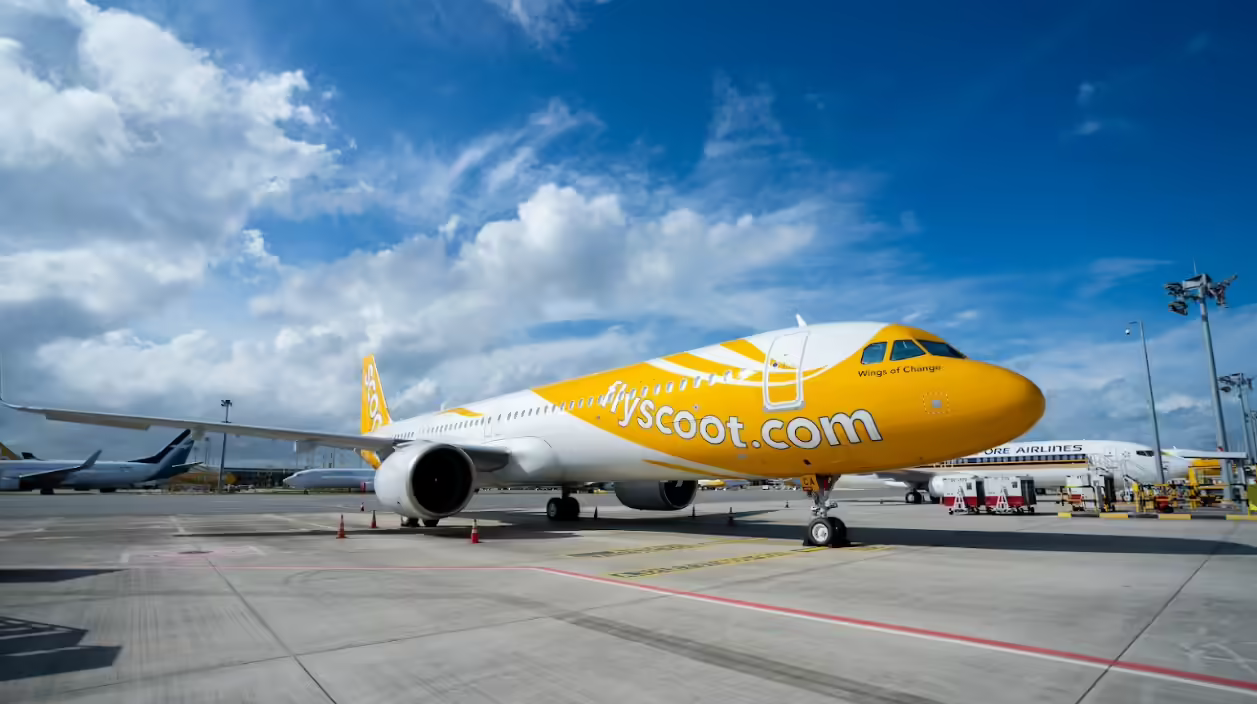
Singapore-based low-cost carrier Scoot has announced a significant fleet expansion with a firm order for five additional Airbus A320neo family aircraft, alongside the exercise of options for six more jets from its earlier agreement with Airbus.
The new aircraft, which will be progressively delivered from 2028 onwards, mark a continued investment in fleet modernisation and capacity growth as the airline positions itself for long-term expansion across the Asia-Pacific aviation market.
Expanded orderbook and next-generation fleet strategy
With this latest order, Scoot’s total A320neo family orderbook will rise to 20 aircraft. The new aircraft will be powered by Pratt & Whitney PW1100G-JM (GTF) engines, known for improved fuel efficiency and reduced emissions compared to previous-generation models.
The Airbus A320neo aircraft will be configured with 186 seats, while the larger A321neo variant will feature 236 seats, all in a single-class layout designed for high-density, short-to-medium-haul operations.
The expansion reflects a broader fleet optimisation strategy focused on efficiency, flexibility, and sustainability as airlines continue to navigate evolving demand patterns in post-pandemic air travel.
Strengthening regional and hub connectivity
The additional aircraft will significantly enhance Scoot’s operational flexibility across a five- to six-hour flight radius, enabling the airline to launch new routes and increase frequencies across key regional markets.
As a key component of the Singapore Airlines Group network, Scoot’s expansion is expected to strengthen connectivity between Southeast Asia, North Asia, and emerging secondary cities, reinforcing Singapore Changi Airport as a major global aviation hub.
By June 2026, Scoot is projected to serve 85 destinations, representing nearly half of all destinations connected via Singapore. Of these, 37 routes are exclusively operated by Scoot, highlighting its role in opening direct city-to-city links and stimulating new travel demand across underserved markets.
Fleet modernisation and sustainability push
Scoot currently operates a diversified fleet of 63 aircraft, comprising:
- 24 Boeing 787 Dreamliners (long-haul operations)
- 30 Airbus A320 family aircraft (narrow-body operations)
- 9 Embraer E190-E2 regional jets
As part of its ongoing fleet renewal programme, Scoot plans to phase out its six remaining A320ceo aircraft by 2028, replacing them with next-generation fuel-efficient models.
Since 2024, the airline has progressively introduced Embraer E190-E2 aircraft, recognised among the quietest and most fuel-efficient regional jets in their category. In parallel, Scoot has been integrating A320neo and A321neo aircraft into its operations, replacing older generation narrow-body aircraft.
The Airbus A320neo family is expected to deliver up to 20% lower fuel burn, resulting in significant reductions in carbon emissions and supporting the Singapore Airlines Group’s net-zero emissions target by 2050.
Strategic outlook for Asia-Pacific growth
Scoot’s expansion comes amid sustained recovery and growth in Asia-Pacific air travel demand, particularly in the low-cost and value travel segments. The airline’s multi-aircraft fleet strategy—combining regional jets, narrow-body aircraft, and wide-body long-haul aircraft—enables it to operate across a broad spectrum of routes.
According to Scoot Chief Executive Officer Leslie Thng, the airline anticipates continued growth in regional travel demand and is positioning its fleet accordingly.
He noted that the A320neo family will play a central role in expanding network reach and improving connectivity within the broader Singapore Airlines Group ecosystem, offering passengers more seamless and flexible travel options.
Enhancing Singapore’s aviation hub status
The latest fleet expansion reinforces Singapore’s position as a leading global aviation hub, supported by strategic investments in fleet modernisation, route development, and operational efficiency.
By expanding its narrow-body fleet and strengthening regional connectivity, Scoot is expected to play a key role in feeding traffic into long-haul services operated by Singapore Airlines, further integrating Singapore’s aviation network across multiple travel segments.
As delivery of the new aircraft begins from 2028, Scoot’s expansion strategy is set to contribute to increased capacity, improved fuel efficiency, and stronger connectivity across Asia-Pacific’s rapidly evolving aviation landscape.